Feature
Number One
"There's one thing no prompt can build."
 Payment orchestration platform
subscriptions · chargeback management · fraud prevention · indirect tax management · banking
AJAX · Bolt · MEGOGO · Nova Post
The world is changing
The world is changed.
AI is the EQUALIZER
You don't need to string copper wires when the technology has already moved on. Countries that skipped the wired era are winning today as much as the ones that laid those wires for a hundred years.
The moats are gone. Every company is on the same field. The only question left — how are you building?
Quality will be the DIFFERENTIATOR
When anyone can ship, shipping is no longer the advantage. The product that works reliably, behaves predictably, and doesn't surprise its users — that's the one that survives. That's Feature Number One.
Our Feature Number One
Not a vibe. Not a slogan. Three numbers that move with the product.
- 99.9999% uptime + one slow-running defect → GMV still bleeds.
- GMV and uptime green, but a merchant sees a UI defect → they stop trusting the processing too.
- Only when all three are green do we actually ship trust, not just uptime.
What's your One?
Every product has one thing it cannot get wrong. Not features. Not speed. The one promise that, if broken, breaks the whole product.
Find your One. Defend it. That's your Feature Number One.
New Challenges
AI cuts both ways: new opportunities, new challenges.
There is no Best-Practices Playbook
AI-assisted engineering is less than two years old. Agentic workflows — where the AI drives the tools — are barely a year. Nobody knows the right way yet. What worked yesterday might break tomorrow — models, context, and tools shift every month. The experience hasn't crystallised into canon — we're in the trial era, not the textbook era. Every team building today is an expedition.
AI didn't create the input-quality problem — it made it visible
Input quality has always decided outcomes. But when a task and its result are separated by weeks and dozens of people, the link blurs. AI compressed the feedback loop to seconds. Write a prompt, see the result, immediately know where the problem is. For the first time in the history of development, the link between input quality and output quality is so obvious you can't ignore it. AI didn't create the problem. It made it visible. Like an X-ray.
A quarter's work in days
Rebuild a whole feature. Tweak every UI element. Restyle the entire product — in a single sitting. What took a quarter now takes an afternoon. The old processes were built for expensive change: long planning, staged approvals, big-batch releases. At this speed those rituals don't protect quality — they just slow it down.
When change is this fast, the old process is the bottleneck.
Product consistency is under threat
The AI isn't trying to break things — it just "understood differently." Avoiding unexpected changes becomes its own discipline.
Our Playbook
A NEW ERA IS ROLLING IN STOP AND THERE'S ONLY ONE THING THAT SURVIVES IT STOP END
=O LAKOVYCH FEATURE NUMBER ONE=
Input quality is the foundation
Domain. Architecture. Features. Three vertices of a triangle — each holds up the other two.
- brieflist of entities and their relations
- deepER model, invariants, lifecycle
- briefone-page service map
- deepADRs, sequence diagrams, API contracts
- briefone-line feature cards
- deepfeature specs, edge cases, acceptance criteria
Brief is for search. Detailed is for work. AI generates from exactly what's here.
Architecture that answers back
Agent-driven code review
Most defects live in the code itself — an agent that reads the diff catches the obvious ones without running a single test. One per defect class, in parallel on every MR, so the defect dies before a human opens it.
- Unoptimized queries that fall over at production scale
- Payloads that violate the specification
- Tests written to pass, not to prove
- Access granted without a permissions check
The earliest review is the cheapest. The cheapest? Reviewing code you never wrote.
Untested code is unfinished work
Tests aren't a follow-up task. A feature without them is a draft — it works until the first change. AI made tests cheap to write; the last excuse is gone. Code and its tests ship in the same merge request.
Done means tested.
How many tests is enough?
One question to the great master: "What code coverage should I aim for?" Three answers.
The third wanted a simple answer — and wasn't going to follow it anyway.
Test Coverage with Context
You could always hit 80% with tests that prove nothing — no real-world cases, no acceptance criteria behind the green. Reviewing every test for actual value never scaled for humans. With AI it does. The gate stops being a number and becomes confidence.
Golden rule: E2E never changes without review.
Shift left — cover right
A real page: a list of orders. 15–20 filters — email, ID, date ranges, statuses — plus results, sorting, pagination.
Cover it all with E2E? Real data for every validation, every filter, every range and every page — slow to write, slow to run, brittle forever.
Same confidence — a fraction of the cost. Cover each behavior at the lowest level that can catch it.
Quality can't be tested in. It's engineered.
Quality lives in the decisions you make at design time: where to draw the boundaries, how to structure the system, which contracts to set. Tests only verify what those decisions already made true.
- A clean boundary removes a whole class of bugs. A test catches one instance of it.
- Where state lives, how services talk, what's coupled — that's where quality is won or lost.
- Changeability, observability, failure behavior — designed in, or absent. Tests can't add them after.
You can't out-train a bad diet — and you can't out-test a bad design.
Quality is owned by engineers
AI can write the tests. Only the engineer who ran the flow end-to-end knows if the product actually works — and knows the product well enough to make the next iteration easier.
- No automation smells bad UX: a flow that sounds great in the ticket can feel terrible in the hand.
- Exhaustive testing is impossible — you'll never cover every case. At least not yet.
- The 3–5 person chain collapsed to one owner, end to end — accountability is a name, not a team.
Harness engineering
AI does the task, automated checks judge the result. Failed — AI retries, up to N attempts. Still red — the harness calls the engineer. Only verified work comes out, and nobody babysits the steps in between.
- Mass changes across the codebase
- Minor bugs that live in the backlog forever
- Backfilling specific test coverage
- Dependency upgrades rolled out across every service
A task repeated a hundred times is one harness, not a hundred tasks.
Veritas
Our harness-engineering agent. It takes the queue of small, well-specified tasks and runs the loop on its own — spec, attempt, checks, retry — escalating only when it's stuck.
Mass changes · Test coverage · Small fixes

AI defect investigator
An order is stuck. Before a human opens the laptop, five leads are already being pursued — in parallel.
“Order stuck in processing for 12 minutes. Was the card charged? When will it resolve? Customer wants an answer now.”

Pursue the leads on the previous slide. The verdict arrives when the investigation closes.

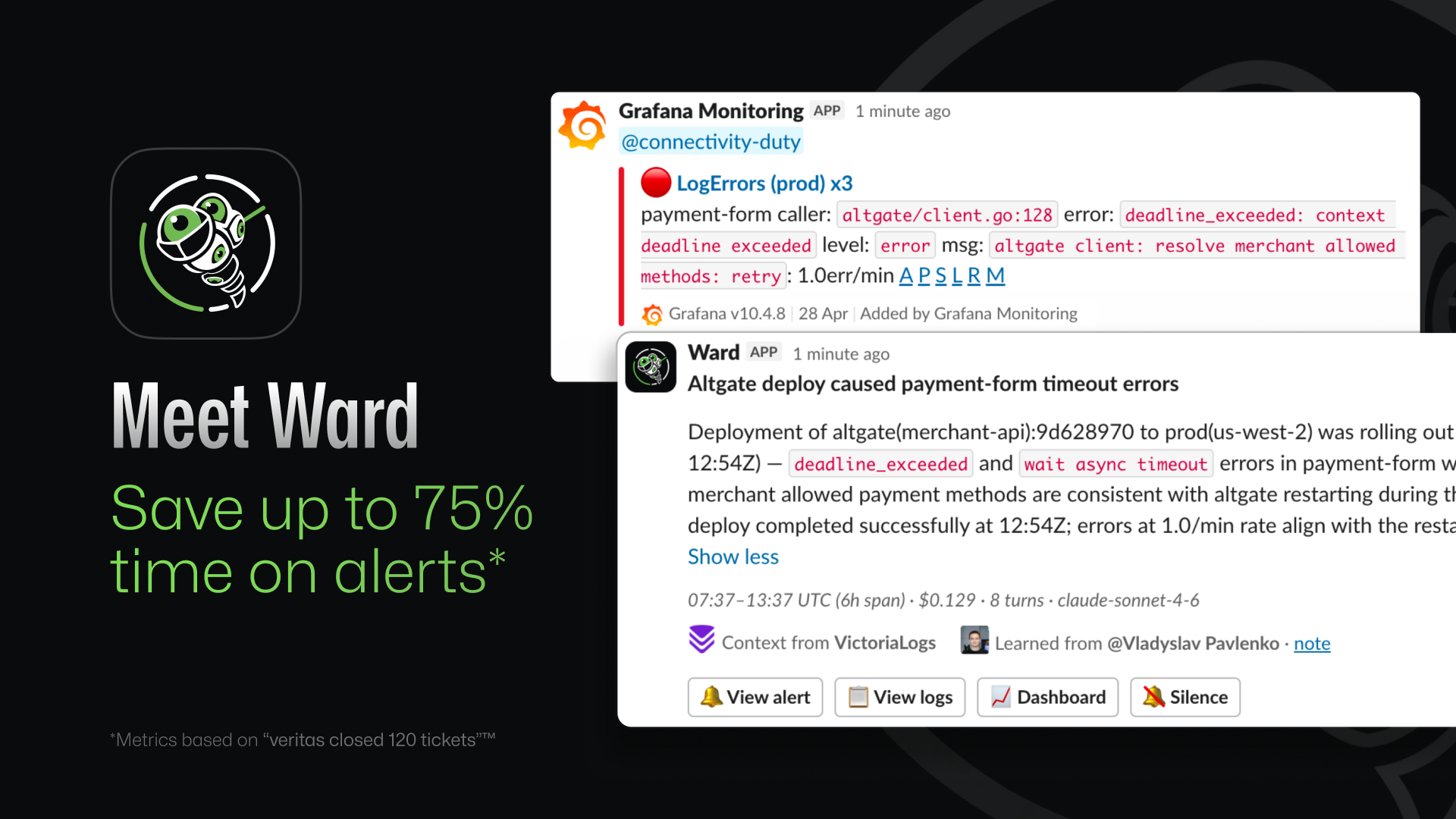
Ward — AI on-call agent
A Grafana alert fires — Ward turns it into a structured root-cause report, right in the alert's Slack thread.
Reads everything. Invents nothing.
- Read-only: metrics, logs, deploys, Sentry, service map.
- Three reply styles per channel: concise · verbose · structured.
- Lessons: the team teaches it per channel — saved guidance overrides assumptions.


Attitude defines results
Great products are built by people every day, every task, every deploy.

Tom Brady
NFL legend
The greatest quarterback to ever play the game.

Pick #199. Sixth round.
Before any of that — almost nobody wanted him. Here's what they said:
“Awful. Not even on my board. He'll make somebody a good husband or a good medical salesman.”
“A backup. Could be a #2 in this league for a long time. Has the size, but not enough arm.”
“Like him. Just wish he was a better athlete.”
So what made the difference?
At Michigan, Brady was the backup's backup. The starter got 20 practice reps. The backup got 10. Brady got 2. He complained to Greg Harden, the team's sports psychologist — and the answer became the rule of his career. Brady sprinted into every practice snap like it was the Super Bowl. Two reps became four, four became ten — ten became the starting job.
“You'll never achieve greatness doing average most of the time.”
Do Your Best
Today
Every Day